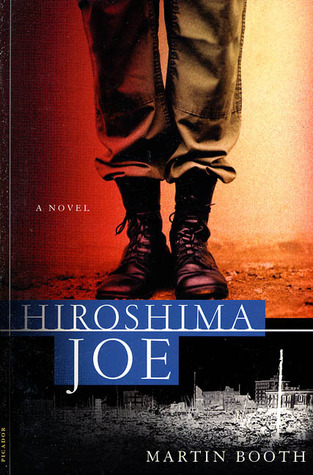
Hiroshima Joe by Martin Booth
My rating: 4 of 5 stars
The kind of books one can come across serendipitously when randomly browsing used bookstores online. Martin Booth, a British novelist who sadly passed away in 2004 after a struggle with brain cancer, was an author whose work I would have otherwise probably never encountered. His most famous works were in the past, and this one especially, from the mid-eighties. But, based on the intriguing synopsis, I got myself a couple of his works, and it is Hiroshima Joe which I picked up finally to have a go at first.
At first glance, the old, tattered paperback looked like it would pose an imposing task. The small print and the dense language took a bit of time to get into, but once I was sucked into the post World War 2 world of Hong Kong, I was hooked for the rest of it. It is a deeply felt, sensory overload, which is also damningly saddening in its depiction of war and its effects (and aftereffects) on everyone, irrespective of ‘victors’ or ‘losers’. For ultimately, the book suggests, no-one wins. This story focuses particularly on one of those nominal losers, a former soldier called Sandingham.
Sandingham was a former Japanese POW, caught in the fall of Hong Kong and transferred to the Japanese slave camps including, with devastating finality, the one on the outskirts of Hiroshima. When the book opens in 1952, he is eking out a miserable existence on the sidelines of society, living permanently behind on his rent in a hotel and stuck in a dizzyingly bottomless haze of opium addiction, thievery, and doing odd jobs for a gangster in Kowloon City called Francis Leung. Obviously haunted by what he has seen and unable to get out of the pull of his memories, he has become something of a joke in the eyes of many around him as a not quite right in the head Englishman called Hiroshima Joe. The tale then goes back and forth in time to the period in the war which leads up to his capture and imprisonment, interleaved with sections in the book’s present timeline of 1952, before eventually finishing up with a poignant coda in 1985.
The war years are described with vivid detail, including the fear and helplessness the probably doomed soldiers face in the face of mounting pressure from the Japanese forces. Sandingham’s time is especially delicate considering his closeted love affair with a fellow soldier in his platoon. His eventual capture comes in the face of irredeemable loss and the subsequent conditions of the POW’s, including the diseases, the starvation and the hopelessness is communicated remarkably well. For some reason, as he himself says during the course of the book, Sandingham survives the camps, punishments and the treacherous journeys till he eventually finds himself in the final camp outside Hiroshima where a horror worse than what he had seen till then awaits.
It would not be a spoiler, considering the name of the book and the character, to suggest that the bomb dropped in Hiroshima plays a major part of the climactic struggle that Sandingham faces. The utter desolation and depravity he observes in the immediate aftermath of the attack is not easy reading and could prove to be a trigger for the uninitiated. But the writing is heartbreakingly effective, and it manages to convey the despair and hopelessness he feels in the human condition that his predicament in post war Hong Kong becomes believable. Also, this is the year that the visionary Christopher Nolan’s Oppenheimer (based on the inventor of the atom bomb) is coming to the big screen and I can’t wait to compare (or contrast) the approaches and the philosophies of this book with that potentially massive film.
Booth’s writing, in both wartime and in 1952 Hong Kong is sensual and impressively descriptive (perhaps excessively so at times) of the time and place the story takes place in. This may also have resonance in his own childhood, which, I am read to believe, he passed a big part of in Hong Kong, even staying in a hotel with his parents for a while where he reportedly did come across an unbalanced former soldier, an experience similar to the one the boy in this story, David, has; someone whom Sandingham tries with increasing desperation to befriend. But, whether there are autobiographical elements or not, the story and the lessons of history he tries to impart are universal in their relevance. War endures. As a poignant dialog that his unlikely Japanese friend in the camps, Mishima, tells him as the complete destruction of Hiroshima lies around him – “Joe,” he said, “I am sorry for what my people did to you and your people; just as you will one day be sorry for what your allies, the Americans, did to the Japanese people. Never forget that it is men who are mad, not nations. Men make wars. Nations do not. Leaders do- who need never fight but send others to die. Politicians are the corrupt ones. They decide but it is we, the common men- the innocent people of the race- who act for them. And suffer in their place.”
To what end does our arrogance and ridiculous notions of honor for a flag blind us? And to what cost? A timeless question posed by what should be a timeless book.
View all my reviews
 DipsicDude