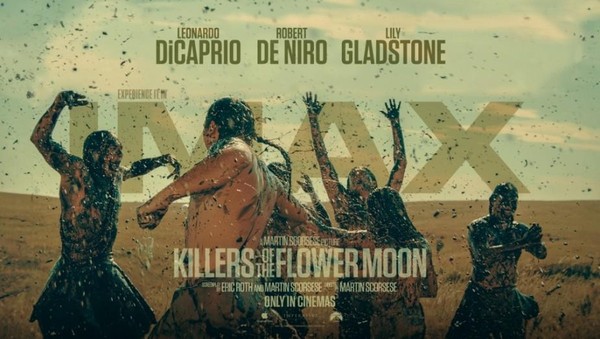
A Scorsese epic needs a certain level of dedication from the viewer. Unlike the superhero films which he decried as ‘not cinema’, it isn’t enough to just show up. One needs to invest in it emotionally and sometimes, gruelingly. The same could be said for ‘Killers of the Flower Moon’, a 3.5-hour epic that demands complete immersion. I thought his last magnum opus, The Irishman, was going to be the start of a retirement from the director what with its magnum opus homage-y take on the gangster genre and re-uniting of De Niro and Al Pacino. But his dedication to this very difficult story to tell results in a staggering film, one which may not be above flaws, but which is capable of rising in spite of them.
The story is based on the non-fiction book by David Grann of the same name, set in the Osage Country in Oklahoma in the 1920’s. The Osage, who had been relocated to the area in earlier years, suddenly become the richest people in the land when oil is discovered under it. But with great wealth comes great possibilities of treachery, and it is this systematic and brutal treachery against the Osage that the book and movie expound on. Scorsese has altered the viewpoint of the book; while that account focused more from the point of view of the fledgling FBI and its investigation into the mysterious deaths which happened, the movie tells the story more as a real-time account of the crimes being committed and the aftermath. This helps in grounding it more in the psyche of the Osage people who suffered the atrocities and making it more real though this may have resulted in the loss of a bit of momentum in the narrative. But I’m assuming this was a conscious decision from the filmmaker to be more authentic to the story and to win the trust of the Osage nation, with whom he is said to have extensive discussions. He has also cast members of the nation in the film as well as taken on others as advisors.
Ernest Burkhart (Leonardo DiCaprio) is back from the war and looking for some gainful employment and something of a life. He winds up at the door of his rich uncle William ‘King’ Hale (Robert DeNiro), who, on the surface, is supposed to be a benevolent supporter of the Osage nation. However, he soon enrolls his nephew into his nefarious scheme. Though the Osage maybe wealthy, there are a number of demeaning and racist rules which keeps them in check, including one which needs them to have a white guardian to use their wealth, and another which states that their wealth can be inherited by marriage to any distant relation alive when they die. King Hale sees the opportunity for his nephew to marry into one such family by making him court and woo the dignified Mollie (Lily Gladstone). Mollie understands that Ernest does want her money but falls for him anyway. To his minor credit, Ernest too is genuine in his feelings for Mollie. But that doesn’t stop him helping his uncle and cousin in preying on and murdering various members of her family in order to get the ‘headrights’ to her wealth. As with a lot of her people, Mollie also needs regular doses of the expensive insulin as she is diabetic. The Osage women in general have a low lifespan, though this could have something to do with their gradual poisoning. When the deaths start piling up, the tribe’s members decide to seek government intervention and after the issue becomes too big to ignore, an officer (Jesse Plemons), of the nascent Bureau of Investigation (which later became the FBI), arrives in town to unravel the sordid secrets behind the killings.

Dicaprio and DeNiro are reliably brilliant in their portrayals as they always are in the films of their long-time collaborator. DeNiro gives a power packed performance as the lord of the land who perhaps himself doesn’t believe he is a villain per se, but just taking advantage of an opportunity. DiCaprio plays the unheroic anti-hero here and his furrowed brows and grimaces reflect that of DeNiro and anchors the film in its mire of desperation and crime. He is a not very intelligent man who desires the trappings of wealth and respect and who is easily played by his uncle and cousin. Lily Gladstone, herself an indigenous American, is a revelation- and brings quiet dignity and grace to most of the scenes she is in, even the ones where she is suffering with her illness. She does fade into the background as the story progresses as Scorsese trains his lens primarily on the villains of the piece.
This is a brutal retelling of a dark episode in American history and one which probably is just the tip of the iceberg when it comes to crimes committed against the native tribes of the continent. As was mentioned earlier, the lack of focus on being a whodunit and instead being an account of the baddies who are known from the beginning does tend to drag it down sometimes. There are a few points in its huge runtime where patience is needed and would make this a movie not suited to everyone’s tastes. But for a movie buff, it is surely a must watch for its remarkable filmmaking authority and acting. Scorsese may be more identified by his gangster epics, and I do find those movies enjoyable, but the movies of his which I love the most are the ones where he strays from the genre, and like gems such as Shutter Island, The Wolf of Wall Street, amongst others, this entry in his filmography is testament to the fact that despite his advancing years his commitment to enthralling filmmaking hasn’t wavered. Long may it continue.
 DipsicDude