
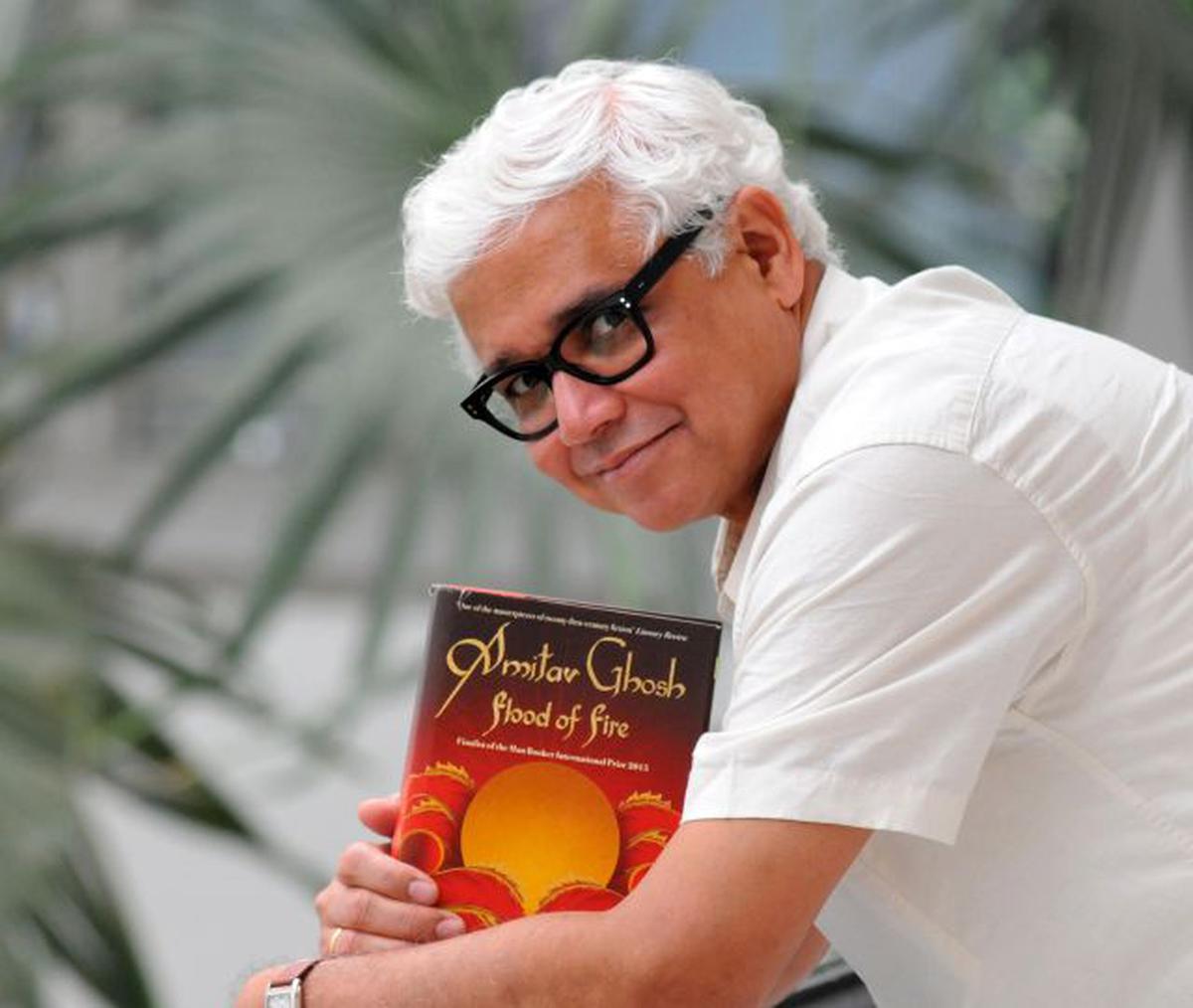
Flood of Fire by Amitav Ghosh
My rating: 4 of 5 stars
Flood of Fire by Amitav Ghosh brings to a close his sweeping, historically rich work of stories based around the first opium war between the British Empire and China during the years 1839-1842. It is the third of a trilogy of an astonishingly fun page-turning epic which doesn’t compromise on its literary ideals. It would really help a potential reader to read the books in order to get a sense of the characters and events as we read them in this, but it can also be read as a standalone. My own history with it is patchy. I started off with the second book, River of Smoke, which I liked enough to turn my tide of indifferent opinion thus far to Ghosh’s writing before I went back a few years later to his Booker shortlisted first book of the series, Sea of Poppies. An impressive yarn, that first book’s faster paced style is what this latest one turns to tell its story.
After the Chinese officials cracked down on the opium shipments coming into their harbours and seized the cargos of the merchants, a diplomatic furore has been ensuing with the threat of war ever looming in the name of protecting free trade. Shireen Modi, wife of Bahram Modi who was betting it all on an extra-large shipment of Opium in the last book, has to face up to the consequences of her husband’s actions as well as the truth of his ‘other’ family in Canton. In order to claim a modicum of respect and a part of the wealth she lost, she decides, with the help of Zadig Bey, her husband’s close friend, to travel to the far east to meet her husband’s illegitimate child, Ah Fatt. But the journey may bring about more changes which affect her social standing in the rigid, small knit community of Parsis.
We also meet Kesri Singh, brother of Deeti, who signs up with an expeditionary force of the East India Company and who forms a close bond over the years with a Captain Mee. He too has to face up to some dark truths and dishonour to his family related to his sister’s disappearance and also help Mee deal with the repercussions of a long-lost love. Zachary Reid, son of a white man and his slave, is passed off for a white man himself and finds himself working for the wealthy Burnhams. His perceived self-gratification comes to the attention of Mrs. Burnham, who decides to take the initiative and act to cure him of his Onanism and save his soul. This portion of the story has some hilarious sequences but also what I felt was a weak attempt to include some raciness and sx into the narrative in an almost soapy form. But the meeting with Mr. Burnham and the introduction to the opium trade is what serves as the pivot to actually turn Zachary’s soul towards darkness. Among other characters there is also Neel Rattan Halder, the former Rajah of Raskhali, who is still on the run from the authorities and who takes up work to help the Chinese effort in the war, both in terms of translations and in chronicling the enemy’s efforts.
It’s all hugely fun and educational. One of the series’ strengths has been the use of the colloquial lingo of the time by the author and he does it in flourishing style here too. All the characters seem to have been carefully invested in, with their tongue reflective of their background and locale. We hear a multitude of words which are both mysterious and strangely captivating. A foremost and funny example are the metaphors used by Mrs. Burnham for her union with Zachary. A few examples –
“It’s my turn now,” Mrs Burnham proclaims, “to bajow your ganta”
“Oh no, my dear, no! You are not chewing on a chichky, and nor are you angling for a cockup! Making a chutney, dear, is not a blood-sport” (on oral sex)
“It is a wonder to me, my dear mystery, how quickly you have mastered the gamahuche!”
There are many other occasions where he inventively but in a way that feels wholly natural to the story includes words of the time into the narrative.
My memory of the characters and events were sketchy at best considering the jumbled order I read the first two books and the gap in years between them. And while I would have preferred to remember everything at the top of my head, it didn’t devalue my reading experience much at all. The book does a good job of once again investing our empathies and sympathies with the characters as they go about the business of living and dying that has been the hallmark of human progress since the dawn of time. And because of chroniclers and storytellers like Mr. Ghosh, the readers and listeners amongst us continue to enjoy and be enriched by their telling. If you haven’t come across this trilogy yet, then make sure to move it to the top of your reading queue.
View all my reviews
 DipsicDude